As COSP 11 comes to a close in Doha, its clear that the fragmented and challenging international environment is continuing to make it hard for States committed to fighting corruption through accountable, transparent and participatory methods to make meaningful headway.
When it comes to asset recovery, we saw also another COSP without a dedicated resolution on asset recovery being tabled by State Parties. Given the ongoing importance of asset recovery as a key pillar of global anti-corruption architecture, this absence means that important current developments in asset recovery are marginalised into other resolutions and not given the prominence they deserve.
Nevertheless, within this environment and thanks to the commitment of states, international organisations and civil society keen to ensure that asset recovery remains an important issue, meaningful progress was made on several fronts.
A Resolution was adopted on enhancing interagency cooperation between anti-corruption bodies and financial intelligence units for effective anti-corruption and asset recovery action. While focussed on anti-corruption agencies and financial intelligence units, it nevertheless included substantial language on asset recovery, highlighting the need to strengthen cooperation, capacity and intelligence sharing in order to effectively identify corruption and recover stolen assets.
Importantly for our priorities, it also included language on data transparency, encouraging State Parties to support the co-production by anti-corruption bodies and financial intelligence units of corruption-related dashboards, typologies, statistical bulletins, and anonymized case studies and lessons learned, as well as to share anonymized data and good practices relating to asset recovery cases.
Both of these provisions establish a strong call for State Parties to enhance their collection of data on asset recovery and publish statistics on assets frozen, seized, confiscated and returned, as well as details on cases they’ve been involved in.
Alongside this, the UK announced in the plenary further details on their project to strengthen the gathering and publication of national level data on asset recovery. Importantly, they were able to confirm that Angola, Malaysia, Norway, Switzerland, and Ukraine had agreed to join the project and would jointly be working to improve grand corruption data transparency, with Kenya signalling its intention to join.
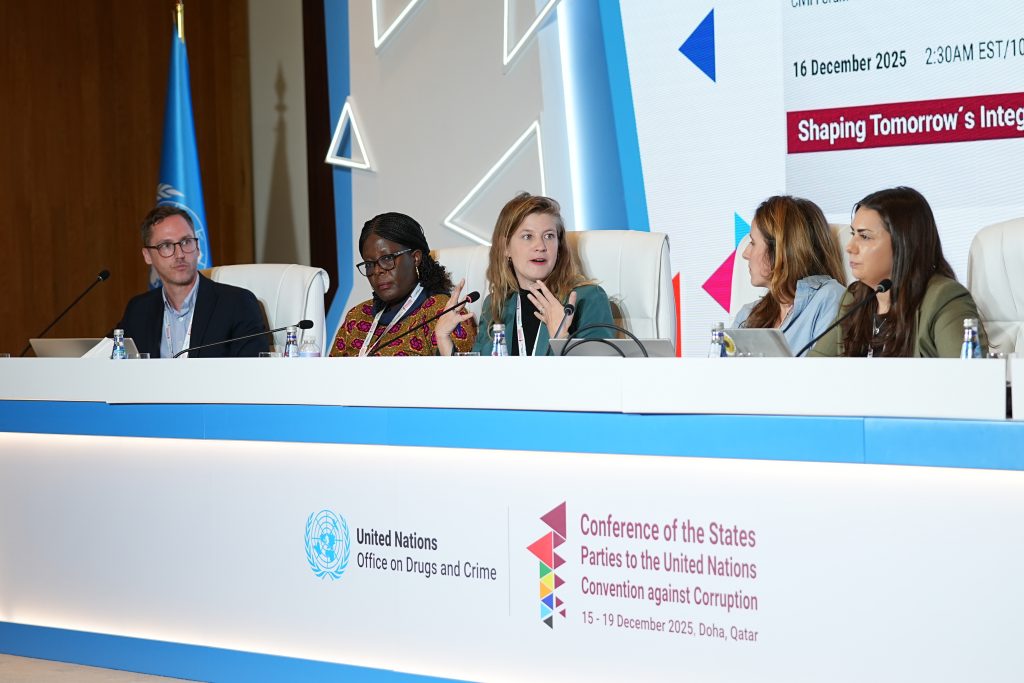
Civil society was furthermore strongly present in Doha and able to get its voice heard. Special events took place on multiple topics extremely relevant to asset return, including on victims, innovative practices and data transparency, as well as on the link to beneficial ownership and case-based analysis – many of which took place in cooperation with States and international organisations, particularly the Stolen Asset Recovery Initiative.
Overall then, a difficult COSP, but one where we were collectively able to make progress in asset recovery despite the challenging environment. Looking to the future and the work will now begin to ensure that these commitments are implemented and we look forward to continuing working with partners to do so.
Photo: “Data Transparency in Asset Recovery and Return” by United Nations Office on Drugs and Crime, CC BY 4.0