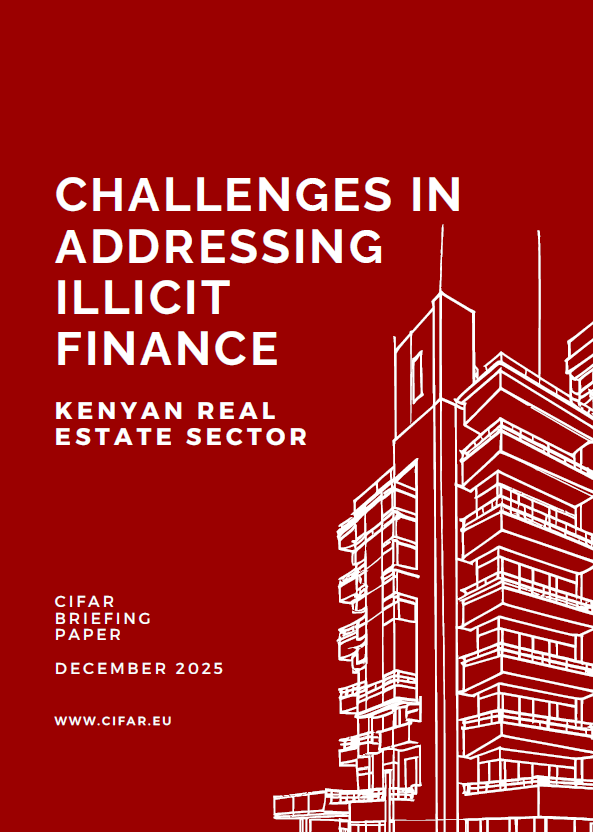
This anti-corruption day, we’re pleased to launch the third of our Kenyan real estate ecosystem papers. This paper looks at the challenges the ecosystem faces in addressing illicit finance.
Illicit finance continues to pose a significant threat to the integrity of Kenya’s real estate sector. Although Kenya has addressed gaps in its anti-money laundering and countering the financing of terrorism (AML/CFT) laws and deficiencies identified in the 2022 Eastern and Southern Africa Anti-Money Laundering Group (ESAAMLG) Mutual Evaluation, the system still struggles in practice. The Financial Action Task Force (FATF) grey‑listed Kenya in February 2024, citing serious deficiencies in its ability to prosecute money‑laundering offenses and weaknesses in its anti‑money laundering and counter‑terrorism financing regime.
The real estate sector remains a high-risk area for money laundering and terrorist financing due to pervasive use of cash, the involvement of politically exposed persons (PEPs), as well as weaknesses in the regulatory ecosystem.
- Illicit funds commonly enter the property market through cash-based transactions, abuse of financial instruments, and opaque ownership structures. Cash is frequently used to avoid reporting thresholds, including splitting up transactions into lower value deposits and cross-border smuggling of currency. In addition, criminals integrate dirty money into the formal financial system via falsified loan documentation, inflated property valuations, straw borrowers, and mortgages repaid with illicit proceeds.
- PEPs involvement is particularly prominent. The use of shell companies, relatives, proxies, and legal representatives, including lawyers, obscures beneficial ownership, while there are weaknesses in verifying ownership and limited interoperability between registries. Domestic PEPs are considered to present a higher risk than foreign PEPs, with lawyers and bankers often facilitating the movement and integration of illicit funds.
- The regulatory ecosystem faces several challenges in responding to these threats. Real estate agents play a central role in property transactions, yet a large proportion operate outside formal structures. Nearly half of real estate firms are not registered with regulatory bodies, and even among those registered, suspicious transaction reporting is extremely low. Barriers to registration keep many agents outside the AML/CFT framework.
Institutions responsible for supervision face resource constraints that limit inspections, training, and compliance monitoring. Some cannot fulfil statutory responsibilities due to insufficient funding or capacity. Industry associations without statutory mandates also lack AML/CFT expertise.
Corruption, political interference, and the centrality of land in political networks make enforcement of AML/CFT rules particularly difficult. Law enforcement agencies may struggle to pursue land-related corruption or money laundering cases involving high-profile political figures. Information is difficult to access, with the beneficial ownership registry not available to civil society and journalists, who could otherwise support efforts to identify illicit finance in the real estate sector.
Finally, the real estate oversight ecosystem comprises numerous actors with potentially overlapping mandates. This fragmentation may create confusion about roles, duplication of effort, and missed opportunities for detection and enforcement.
Addressing these challenges could substantially strengthen the ability of the ecosystem to respond to illicit finance. Yet it will require practical, targeted reforms that go beyond tightening rules. Solutions should focus on making AML/CFT compliance workable for the real estate market as it functions in practice, and on enabling cooperation across ecosystem actors, including statutory bodies, industry associations, and civil society.
About the project
This is part of a series of reports CiFAR is producing under the Corruption in Paradise research project. This project investigates how six tourism-focused cities/regions from Brazil, Kenya, and Indonesia address illicit finance in the real estate market.
The Corruption in Paradise research project is coordinated by GRIP (Public Integrity Research Group) at USI (Università della Svizzera italiana) and also includes FGVceapg (Center for Public Administration and Government Studies at the Getúlio Vargas Foundation’s São Paulo School of Business Administration) and the CACG (Center of Anti-Corruption and Governance Studies) at Politeknik STIA LAN Jakarta.
This research is part of the Governance & Integrity Anti-Corruption Evidence (GI ACE) programme which generates actionable evidence that policymakers, practitioners and advocates can use to design and implement more effective anti-corruption initiatives. This GI ACE project is funded by UK International Development.