

Civil society perspectives on asset repatriation and its use for the realization of human rights
Reflections from the OHCHR expert meeting

This blog is jointly published by CiFAR – Civil Forum for Asset Recovery e.V. the Global Civil Society Coalition for the UNCAC, the Global Survivors Fund, and Transparency International France.
Every year, billions of dollars stolen through corruption are moved across borders — money that could have funded hospitals, schools, and the basic services people are entitled to. Recovering it is difficult and returning it in a way that genuinely reaches the people who were harmed is even harder.
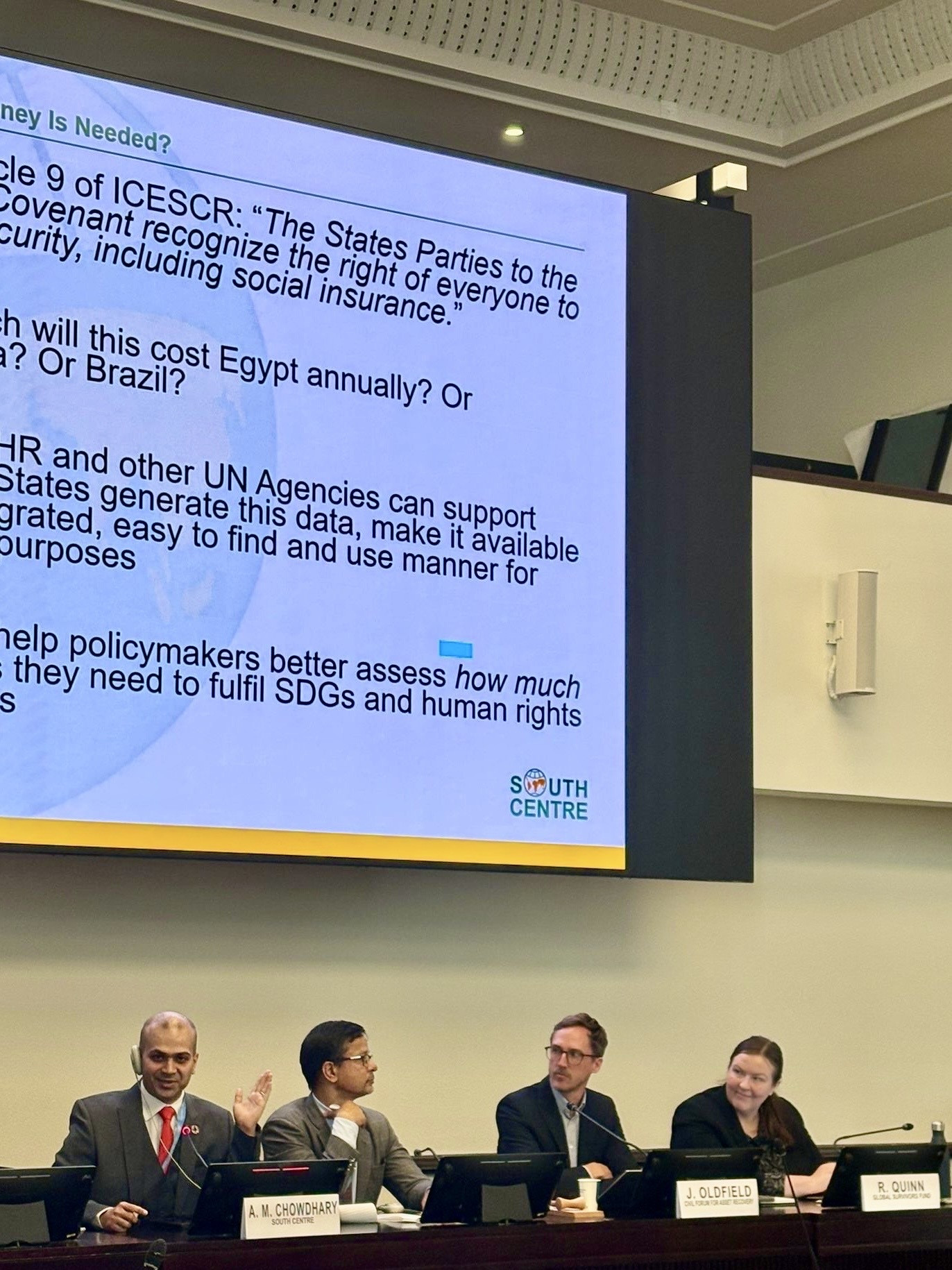
On the 8th of June, our organisations were all invited to speak at the Office for the High Commissioner for Human Right’s expert meeting on strengthening international cooperation for the repatriation of funds of illicit origin and their use for the realization of human rights.
This meeting was part of the implementation of Human Rights Council resolution 58/7. This resolution, adopted in 2025, identifies illicit financial flows as undermining the enjoyment of human rights and argues that these lost resources could otherwise be used for public services, development, poverty reduction, health care, education, and infrastructure.
A resolution that breaks new ground
Beyond making the human rights case, Resolution 58/7 introduces an important mandate: it calls for a dedicated regional event in Africa.
Africa is among the regions most severely affected by corruption, illicit financial flows, and the persistent challenges surrounding asset recovery and the return of stolen assets. By creating a dedicated regional space for dialogue, the resolution helps ensure that the countries and communities most affected by these challenges can contribute directly to shaping the agenda and identifying solutions. This is an important step towards a more inclusive, representative, and responsive global conversation on corruption, asset recovery, and human rights.
The connection between human rights and the recovery of stolen assets is an important one and to date there has been too little interaction between the UN human rights bodies and anti-corruption processes, given the scope of the challenge.
The scale of the problem
As many of the High-Level speakers at the event identified, this is a multi-billion dollar a year loss in revenue, particularly to countries with already constrained resources and at a time when international development assistance is at historic lows. To put it into context, UNCTAD (United Nations Conference on Trade and Development) estimates that US$ 88.6 billion annually is lost per year in illicit financial flows from Africa.
Our organisations highlighted that change is needed, and is needed fast, to push asset recovery up on the agenda and to make it work for people suffering harm due to the human rights impacts of illicit finance.
The priorities we put forward
Ruth Quinn, Senior Advocacy and Policy Officer on Reparation Financing at the Global Survivors Fund called for asset recovery and return processes to address the full system of harm that corruption creates, in particular where it fuels violations such as conflict-related sexual violence, torture and enforced disappearance. Secondly, States should consider how asset return can be used to finance reparations for corruption-enabled harms. Third, victims and survivors must be involved in decisions on the reparative use of returned assets, because they are best placed to design reparations that respond to the harms they suffered.
“If illicit funds were generated, protected or moved through systems that harmed people, then their return should help repair harm. The test of effective asset return should be whether recovered assets advance rights, reach affected communities, support remedy, reparation and recovery and help rebuild trust between victims and institutions.”
Sara Brimbeuf, Senior Advocacy Officer, Illicit Financial Flows at Transparency International France highlighted that asset recovery is not prioritized enough by governments. The absence of a dedicated asset recovery resolution during the last two sessions of the UNCAC Conference of the States Parties suggests that, while the issue remains on the agenda, it no longer receives the sustained political attention it requires.
“The data is clear: asset recovery remains underreported and under-prioritised. Half of UNCAC States Parties have never reported their asset recovery efforts to the StAR Initiative, and of 48 Venezuelan-linked cases worth around USD 3.9 billion, only one appears in the Asset Recovery Watch database.”
Speaking on behalf of CiFAR – Civil Forum for Asset Recovery e.V., Jackson Oldfield argued that we should be thinking about human rights in both outcome and process. He suggested it is not enough to return funds for sustainable development or for the advancement of human rights if decisions are made without taking into account the rights to information and participation of those affected by corruption.
“Ultimately, I don’t think asset recovery is only about recovering funds. I believe it is about using the return as a catalyst to advance broader human rights, development and good governance goals. It’s therefore essential that restitutions not only aim at these goals but include them as core principles within the returns themselves.”
Mathias Huter, Managing Director of the Global Civil Society Coalition for the UNCAC, underscored that part of the solution to this problem lies in greater cooperation between work being done in Geneva and Vienna. In particularly he highlighted that resistance to progress in asset recovery in Geneva was not resulting in countries taking action in Vienna.
“A number of countries, many from the global North, opposed Resolution 58/7, arguing that the issue belonged in Vienna under the UNCAC. Yet in Vienna, we have not seen the momentum needed to advance asset returns and to strengthen transparency and inclusion in the process. We believe the human rights fora in Geneva and the UNCAC fora in Vienna should be complementary and mutually reinforcing, and we encourage States to promote the same agenda in both, to ensure we make meaningful progress.”
From Geneva to Vienna: Building a more coherent approach
Looking ahead, the challenge will be to ensure that these conversations continue across relevant international fora. The adoption of Resolution 58/7 creates an opportunity to strengthen the links between discussions taking place in Geneva and those in Vienna under the UNCAC framework. Rather than viewing these processes as separate, there is significant value in recognising their complementarity.
The issue of asset repatriation presents an important opportunity to promote greater policy coherence and mutual reinforcement between the two processes. Consistent engagement across both Geneva and Vienna can help ensure that asset recovery and return efforts are effective, transparent, and can also be responsive to the needs and rights of those affected by corruption.