

Putting victims at the centre of asset recovery: Reflections from the OHCHR expert meeting in Addis Ababa
In June, we joined civil society organisations and other stakeholders in Geneva at the Office of the High Commissioner for Human Rights’ (OHCHR) expert meeting on strengthening international cooperation for the repatriation of funds of illicit origin and their use for the realization of human rights. We left that discussion with a clear message: asset recovery is not only about where stolen money goes, but also about who has been harmed and who gets a say in what happens next.
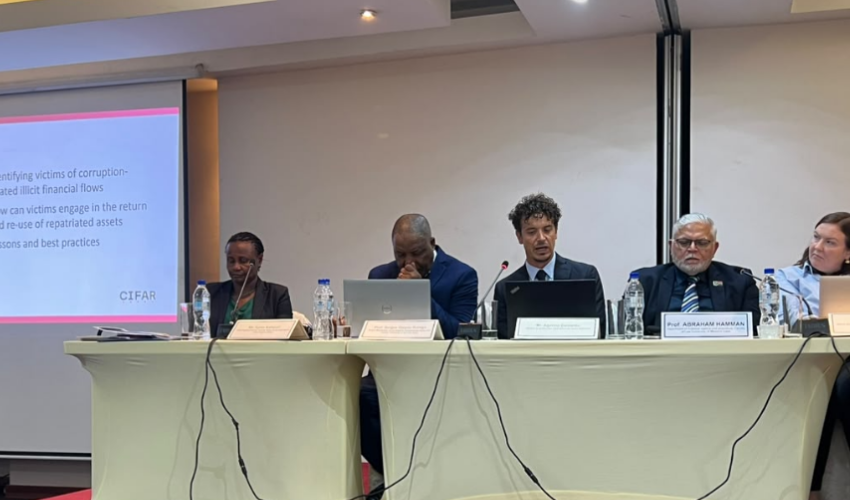
That conversation continued on 25th and 26th August, when we attended the OHCHR expert meeting in Addis Ababa on supporting governments’ efforts to repatriate funds of illicit origin to advance economic, social and cultural rights and the right to development.
This time, the discussion focused more closely on a question that is fundamental to making asset recovery work for people: who are the victims of corruption and how can they be meaningfully compensated and involved in asset recovery?
Who are the victims of corruption?
Identifying victims of corruption is not straightforward. In many cases, corruption does not produce one clearly identifiable person or group who has suffered a quantifiable loss. The effects can be spread across communities and societies, through reduced access to healthcare and education, deteriorating infrastructure, lost economic opportunities or the diversion of public resources.
This is particularly challenging in cases of grand corruption and embezzlement. A person may be harmed because money that should have funded a public service has disappeared. Demonstrating that this individual has suffered the specific and direct harm required by many legal systems can, however, be extremely difficult. Collective victims face similar challenges: entire communities may have suffered, while the law may struggle to give them standing as victims.
As we highlighted in our report on Victim Inclusion in Asset Recovery, traditional approaches to identifying victims often fall short because corruption produces diffuse and indirect forms of harm. Anti-corruption frameworks, including the UNCAC, provide limited guidance on who qualifies as a victim, while many jurisdictions do not have specific definitions of corruption victims.
This matters because what cannot be identified is often difficult to repair. If victims are not recognised, they may have no opportunity to participate in proceedings, seek compensation, influence decisions about recovered assets or monitor whether those assets ultimately benefit affected communities.
Human rights can help make victims visible
Human rights frameworks offer useful tools for addressing some of these gaps.
International human rights law does not treat corruption itself as a human rights violation. But the frameworks to address harm caused by human rights violations can be of great help to address harm from corruption. International human right law establishes clear and meaningful ways to address rights to information, participation, access to justice and an effective remedy. The tool developed to fulfil these rights obligations can help shift the focus from corruption as an offence against the State towards the people whose rights and lives have been affected.
This is particularly important where the harm is indirect or structural. Looking at corruption through a human rights lens can help identify how stolen or misused resources affect the enjoyment of rights such as access to healthcare, education, equality and justice. It can also place responsibilities on States not only to investigate wrongdoing, but to ensure that people affected by it have meaningful avenues to seek redress.
This is also where the concept of social reuse of recovered assets becomes important. Rather than treating recovery as the end of the process, recovered assets can be redirected towards public services and community needs. In such cases, returning assets to affected communities can function as a form of collective reparation. The challenge is then to ensure that those communities have a meaningful role in deciding how the assets should be used.
What does it mean to involve victims?
Victim participation can begin during investigations and recovery proceedings, with victims being informed about cases, given opportunities to provide information or evidence, and able to express their views. It can also involve access to justice and meaningful avenues to seek compensation or other forms of remedy.
At the OHCHR expert meeting in Addis Ababa, we presented the civil society principles on meaningful victim inclusion in asset recovery:
Funds should be returned swiftly to identifiable victims or groups. Where victims cannot be identified, funds should be returned to the communities and peoples from whom they were stolen.
Legal and policy for victim compensation should include broad definitions of victims in corruption cases and should be applicable to both domestic and international recoveries.
Where individual victims cannot be identified, or direct compensation is impractical, open and accessible public consultations must be held to determine the allocation of funds to broader groups of victims.
All victims must have the opportunity to participate without discrimination, with transparent decision-making and the right to appeal any irregularities.
Monitoring recovered assets: from participation to accountability
Participation should continue after assets have been recovered. One practical area where victim inclusion can already make a difference is the monitoring of recovered assets.
Victims and civil society organisations can help oversee what happens after assets are returned: where funds are allocated, how they are spent, whether promised projects are implemented and if the intended communities actually benefit. This is not simply about auditing expenditure. It is about giving affected people a role in assessing whether the return is achieving its intended purpose.
There are already different models for this, as CiFAR has explained in its Monitoring Guide on Recovered assets: civil society organisations can have a formal role within return mechanisms and asset management structures, be explicitly designated as independent monitors through agreements between States or conduct independent monitoring and advocacy where no formal role exists. Promising examples include returns involving Nigeria, Moldova, Kazakhstan and Uzbekistan, as well as cases where civil society has independently followed the use of recovered assets.
At the OHCHR Expert Meetings in June and August we pointed towards the same conclusion: asset recovery should not stop when money is recovered or returned. A truly victim-centred approach asks who was harmed, how that harm can be addressed and how affected people can participate throughout the process.