
Strengthening collaboration in illicit finance and asset recovery
How can civil society, law enforcement and public oversight bodies collaborate for effective prevention of illicit financial flows and the recovery of stolen assets? This was the topic of discussions we had this week in Nairobi, Kenya.
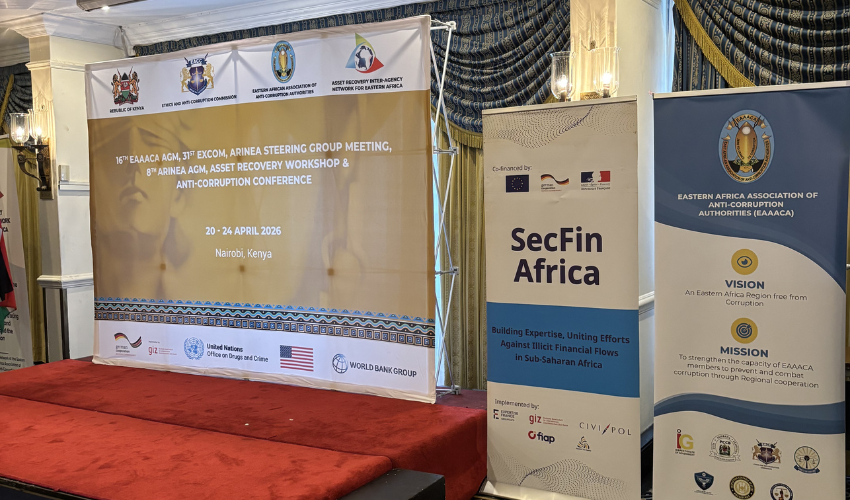
Starting on the morning of the 21 April, we were invited to attend the AGM of the Asset Recovery Interagency Network for East Africa (ARINEA). ARINEA is a network of practitioners in the Eastern Africa Region of anti-corruption agencies that aims to share information on individuals, companies and assets, with the aim of recovering the proceeds of crime. Similarly to other regional asset recovery interagency networks, it focuses on informal information sharing and exchange, seeking to overcome institutional barriers that may otherwise restrict the effectiveness of asset recovery efforts. As highlighted in the meeting, ARINEA has facilitated over 90 informal requests for cross-border information exchange relating to asset recovery.
This ties very well into the other meeting that took place at the same time in Nairobi. Starting in the afternoon of the 21st, we held a project meeting of all partners from our Corruption in Paradise research project. This project, spanning Kenya, Brazil and Indonesia and led by the Università della Svizzera italiana, aims to uncover the role of illicit finance in the real estate market in the three countries and propose innovative solutions to how the ecosystem of actors within the sector can address the challenges this poses.
What is the link? Our research shows into the Kenyan real estate market shows that Kenya is a regional hub for illicit finance. Corrupt actors are laundering the proceeds of crime both from within Kenya and from the broader East Africa Region, as well as some global actors, into the property market in Kenya.
Initiatives such as ARINEA therefore are a vital part of the response to illicit finance in the real estate market. Close collaboration between law enforcement, and with civil society, is essential to identify those corrupt actors, understand how they are moving corruptly acquired assets and collaborate on prosecuting those involved and recovering stolen assets. Similarly, research such as ours, coming out of civil society, can help networks such as ARINEA understand the weaknesses that are allowing illicit finance to flow across borders and take steps to address these.
We look forward to continue to work with ARINEA and other partners to strengthen collaboration between law enforcement and civil society organizations and together to address weakness and return the proceeds of crime and corruption to the people from whom they were stolen.
---
The ARINEA meeting was supported by the SecFin Africa project, cofinanced by the European Union, GIZ and France. The SecFin programme supports work we are doing to support asset recovery efforts in West Africa. You can find out more about this project here.
The Corruption in Paradise research project is coordinated by GRIP (Public Integrity Research Group) at USI Università della Svizzera italiana and also includes FGVceapg (Center for Public Administration and Government Studies at the Getúlio Vargas Foundation's São Paulo School of Business Administration) and the CACG (Center of Anti-Corruption and Governance Studies) at Politeknik STIA LAN Jakarta.
This research is part of the Governance & Integrity Anti-Corruption Evidence (GI ACE) programme hosted at the Centre for the Study of Corruption (CSC) which generates actionable evidence that policymakers, practitioners and advocates can use to design and implement more effective anti-corruption initiatives. This GI ACE project is funded by UK International Development.